About implied courtesy
Also a spoiler-free book review of Kazuo Ishiguro's "A Pale View of Hills".
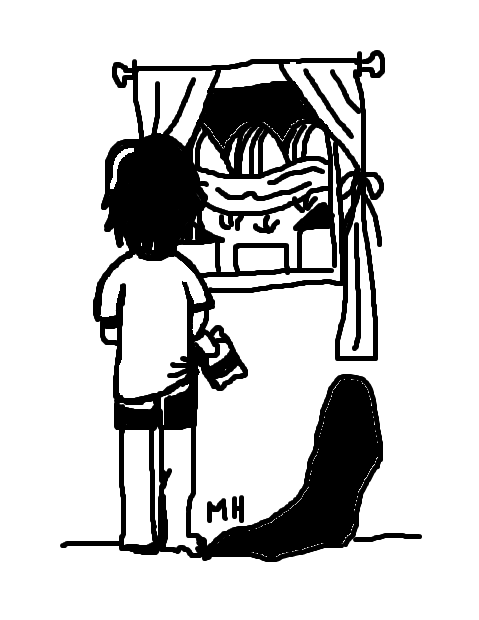
It’s not unusual to go to the library with the intention of dropping off books and coming back home with fifty more. It’s a never-ending TBR list, but now it’s sitting on the shelf instead of on Goodreads or Storygraph. Whenever I go to the library, I innocently meander to my favorites. M for Morrison, Murakami, Murata. K for all my Koreans, the Kangs and Kims, and then Kawakami. O is for the stray Ozeki, B for Butler and Baldwin. In this specific case, it was I who went to the “I” and picked out Kazuo Ishiguro’s debut novel, A Pale View of Hills.
The 183-page book starts like this:
Niki, the name we finally gave my younger daughter, is not an abbreviation; it was a compromise I reached with her father. For paradoxically it was he who wanted to give her a Japanese name and I — perhaps out of some selfish desire not to be reminded of the past — insisted on an English one. He finally agreed to Niki, thinking it had some vague echo of the East about it (9).1
Like, wow, right?? This beginning immediately hooked me. Like, who’s Niki?? Where is the older daughter? What is this narrator’s deal?? What does she mean, reminded me of the past?? And, vague echo of the East, huh??? Tell me more.
The book is told from the perspective of Etsuko, an old Japanese woman looking back on her life. While her grown daughter, Niki, is visiting her in England, Etsuko recalls her life as a young pregnant woman in Nagasaki in the aftermath of the atomic bombs and how tragedy rattled her life and the lives around her—her husband, her father-in-law, her friend, her friend’s daughter, the noodle shop owner, the noodle shop owner’s surviving son. Every character lives out their grief differently, and all have a unique relationship to time. Some only look ahead without reconciling their past; others turn their heads and stay stuck looking back. As Etsuko’s memories fade in and out, she reflects on her relationship with her eldest daughter, Keiko, and slowly, the events of past and present muddle together.
It’s hauntingly beautiful, and a disquieting debut. I’ve read Ishiguro’s later books which also examine the haziness of memory and the handling of loss and grief, as he seems to enjoy writing about how memory can warp perspective or shape thought. But this one felt different. Something about the effect of memory on the collective conscience and the innocuous conversations between characters that hinted towards something deeper. It made me think about how we can use small talk to hide our true feelings, but to also invite someone to read between the lines. How the cultural concept of saving face, or sparing someone humiliation, or being courteous, can leak into language.
Here are some examples of conversations that stuck out to me and what I gleaned from them. All of these conversations are Etsuko’s memories of the past and are set in the aftermath of the atomic bombs, where Etsuko is a young expecting mother. No spoilers—here we go!
First, a conversation between Etsuko and her seemingly only friend in the neighborhood, Sachiko. Sachiko’s young daughter, perceived by her mother as flighty and rebellious, is missing from home and Etsuko suggests that the two of them go search for her.
E: Well let’s go and see.
S: There’s no need for you to come with me. I’ll find her in good time.
E: It’s all right. I’ll come with you.
S: Very well then. Come with me.
E: How long were you out? [pause] How long were you out?
S: Oh, not long.
E: How long? Half an hour? Longer?
S: About three or four hours, I suppose.
E: I see (39).
The first thing that stood out to me was Etsuko’s insistence on finding Sachiko’s daughter and Sachiko’s nonchalant attitude. The second thing was how easily Sachiko obliged Etsuko’s request (“Very well then”) and turned it into her own (“Come with me”). The third was Sachiko’s reluctance to admit the truth, or show any semblance of panic that her daughter is missing. The last is Etsuko’s final “I see” at her friend’s admission. The nonchalance and eerie calmness surrounding the conversation underscores how deeply troubling the situation actually is.
Here is another conversation between Etsuko (E) and her visiting father-in-law, called Ogata-San (O). She refers to him as “Father”, and Ogata-San is about to head out to visit his old friend when Etsuko asks,
E: Are you going out Father?
O: I thought I’d just pay a visit to Dr Endo.
E: Dr Endo?
O: Yes, I thought I’d go and see how he was keeping these days.
E: But you’re not going before lunch, are you?
O: I thought I’d better go quite soon… .
E: Well, let me pack you a lunch-box, it won’t take a minute.
O: Why, thank you, Etsuko. In that case I’ll wait a few minutes. In fact, I was hoping you’d offer to pack me lunch.
E: Then you should have asked. You won’t always get what you want just by hinting like that, Father.
O: But I knew you’d pick me up correctly, Etsuko. I have faith in you (32).
I found this conversation a bit sad and funny because Ogata-San admits that he had hoped for Etsuko to sus out his hungry vibe and cook him a lunch box. Instead of directly asking, he implies this with his language, or lack thereof. Like, the ellipsis after “I thought I’d better go quite soon” says both nothing and everything. (And also, instead of making his own lunch or buying it on the way, he relies on Etsuko’s hand. I will add that somewhere in the book, Ogata-San talks about how he doesn’t really know how to cook and Etsuko teases him for it. So I guess he couldn’t make his own lunch if he wanted to, but he could have still been more forthcoming with Etsuko. Anyhow, these two seem to have the most sincere relationship in the novel according to Etsuko’s memory, so I don’t think this scene is meant to pit them against each other, but rather be read as playful.)
The next convo is another one between Etsuko (E) and her father-in-law (O) many pages later. Etsuko recalls Mrs. Fujiwara, an old neighbor who now runs a noodle shop in town. Remember that Ogata-San is just visiting, so he isn’t aware of what’s up with Mrs. Fujiwara, and especially her life after the atomic bombs.
E: Do you remember Mrs Fujiwara. She runs a noodle shop now. Near Father’s old house.
O: Yes, so I hear. A great pity. Someone of her position running a noodle shop.
E: But she enjoys it. It gives her something to work for. She often asks after you.
O: A great pity. Her husband was a distinguished man. I had much respect for him. And now she’s running a noodle shop. Extraordinary. I’d call in and pay my respects, but then I suppose she’d find that rather awkward. In her present circumstances, I mean.
E: Father, she’s not ashamed to be running a noodle shop. She’s proud of it. She says she always wanted to run a business, however humble. I expect she’d be delighted if you called on her (139-140).
I appreciate Etsuko rising to Mrs. Fujiwara’s defense here. Ogata-San seems very hung up on Mr. and Mrs. Fujiwara’s high status before the war, and he repeats that her given situation is “a great pity” twice. Perhaps in Ogata-San’s own way, he is offering Mrs. Fujiwara condolences for her losses, but he later states that he would feel quite awkward to call her due to her “present circumstances.” He seems more sorry about her loss of status, and not her loss of loved ones or community, and he’s not willing to communicate even that. Such language feels cruel, and Etsuko is upfront about Mrs. Fujiwara’s joy in running her noodle shop. Why can’t Ogata-San accept that maybe Mrs. Fujiwara is really happy running her shop and truly taking ownership of something, maybe for the first time in her life?
Etsuko is really nudging her father-in-law to call the noodle shop lady, but he doesn’t seem particularly inclined to. She too can only be so direct with her language.
And last, one more conversation between Etsuko (E) and Mrs. Fujiwara (M). As a reminder, Etsuko is an expecting mother and visibly pregnant. In this convo, she is visiting the noodle shop and about to leave.
E: I’d better be leaving you soon. You’re very busy just now.
M: You just stay there and relax. You’ve only just sat down. I’ll get you some lunch.
E: No, that’s all right.
M: Now, Etsuko, if you don’t eat here, you won’t eat lunch for another hour. You know how important it is for you to eat regularly at this stage.
E: Yes, I suppose so.
M: You’ve everything to look forward to now, Etsuko. What are you so unhappy about?
E: Unhappy? But I’m not unhappy in the least.
M: Once the child comes, you’ll be delighted, believe me. And you’ll make a splendid mother, Etsuko.
E: I hope so.
M: Of course you will.
E: Yes. (77-78)
Among many other things, this conversation reflects the kind of “No, no, no, I insist!” attitude that one might receive from an aunty or an older relative. The somewhat, “I understand you, but I also know what’s better for you!” kind of mindset. As a receiver of such comments, one might find it difficult to leave out of disrespect. One might also find it difficult to say no to food, a gesture of care. Or maybe one would just firmly decline and walk out, I don’t know. What I find interesting is how Etsuko doesn’t really object to Mrs. Fujiwara’s insistence. I feel like her noncommittal, easily-swayed answers underscore a deeper feeling of unease that she has, highlighted even more by Mrs. Fujiwara’s “What are you so unhappy about?”
When some authors write dialogue, they don’t always write in facial expressions or body language (unless they’re Sally Rooney who includes things such as a fluttering hand or a blinking of the eyes, but also excludes things such as quotation marks, but that’s neither here nor there). Sometimes, it’s up to the reader’s imagination to think through how the situation plays out. Other times, it feels like I’m reading a chatroom and I forget where the characters physically even are. What I liked about this conversation is how Mrs. Fujiwara outwardly observes some kind of sadness in our dear protagonist that she herself is not willing to admit or examine. Of course Etsuko should be happy, she’s to have child! But how does Etsuko actually feel? This conversation gives us a glimpse into Etsuko’s feelings on the baby that she is apparently so happy to have, but never really talks about in the story. What may be more haunting is Etsuko’s insistence that she is not unhappy in the least.
After I explained this Substack idea to my friend, she showed me an Instagram reel, as members of Gen Z are prone to doing. If you do not have the Instagram app, allow me to explain what’s going on.
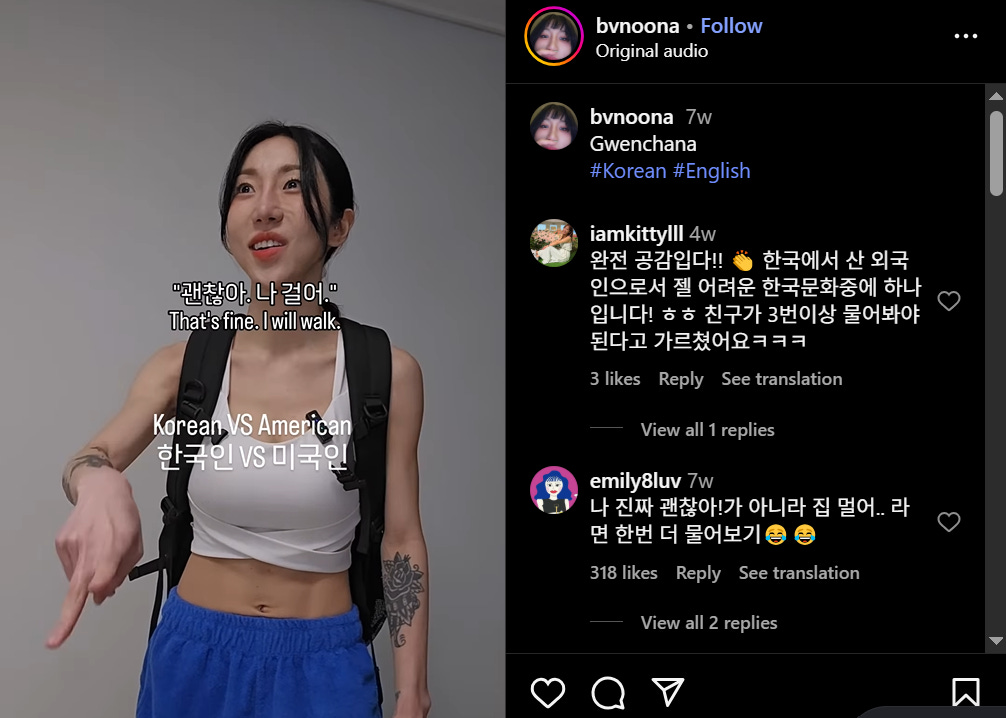
At the start of the reel, an American person asks an American person if they need a ride. The video then goes through various imagined conversations where a Korean is involved—an American asks a Korean, a Korean asks a Korean, and a Korean asks an American. In the latter scenario, the American declines the ride at first, saying she will walk, and the Korean person insists. The American declines again, and the Korean insists once more. The American gets agitated, and declines the ride again. The scenario ends with the Korean being fed up, and cutting to text blocks explaining how Koreans will assume someone is declining an offer out of courtesy unless a reason is stated. The reel’s purpose is to highlight the cultural differences in communication between Americans and Koreans.
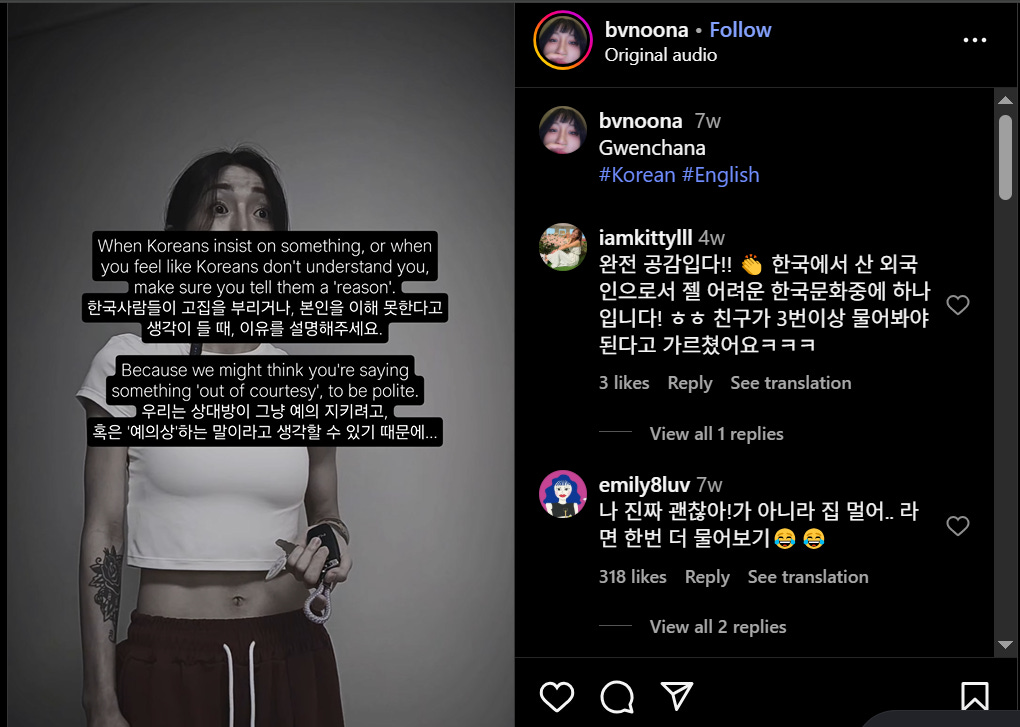
In the reverse scenario, the American asks the Korean if they need a ride, and the Korean responds that their house is far away and that maybe the American is tired, and then the American says okay and walks away. The Korean is left aghast, as she would have appreciated the ride, but declined out of politeness and as to not impose herself. The reel calls this “out of courtesy” culture, but my friend explained it as “implied courtesy” and I liked that better.
Kazuo Ishiguro’s book… this Insta reel… Better Late Than Single on Netflix… conversations with my own family members… reminded me of this. How often am I using implied courtesy in my own speech and bending away from my own desires? How often am I judging other people for accepting or declining things at face value? Some people may read A Pale View of Hills and think, Ugh, this is so boring, nothing is happening. Why does everyone keep repeating themselves? But somehow, I read it and felt delighted that someone could so clearly capture implied courtesy in the English language. As a reader, I was intrigued by the silences and repeated formalities in the conversations, and it made me think about how Koreans say (or don’t say) similar things. I enjoyed being able to understand things in nuanced ways because of my sort of bilingualism, and to see parts of myself in unexpected places.
Language is cool! Culture is even cooler! My goal is to one day be able to read Korean literature in its original form, and maybe even translate something, because capturing nuance in words seems challenging but really interesting! But I first need to learn more vocab and be able to get through a children’s book and also my own insecurity about language learning… but we’ll get there.
Anyway, I hope if this stack was interesting to some degree, you’ll consider reading A Pale View of Hills. If not that, perhaps Klara and the Sun or The Remains of the Day or Never Let Me Go — whatever is available in the “I” fiction section at your library.
-MH <3
I will be quoting from the First Vintage International Edition published in September 1990. The book itself was first published in 1982.
Your review of A Pale View of Hills feels fluent and full of care, thanks for sharing your thoughts! Also the vibe lowkey sounds like Pachinko, which is one of my favorite books. Going on my TBR!
Personally I always struggled with implied consent growing up as a first gen ABC. From this vibe wrecker to a vibe checker, do you personally prefer being a part of a culture that communicates more via direct or indirect communication?
Kazuo ishiguro is one of my favourite writers and never let me go is my favourite book of all time 😭 you always write about such compelling topics! a few days ago my director asked me if I’d like a coffee and I blurted out “no, but thank you so much” almost immediately, although i did in fact want a coffee…anyway this reminded me of that.